

Storage of flammable and water hazardous liquids in accordance with regulations
Those who work with substances that are hazardous to water or are flammable are obliged to store hazardous substances in compliance with the law. In order to avoid risks to both people and the environment, a number of legal regulations specify clear requirements for the storage of these hazardous substances. These requirements must be strictly implemented, in particular in commercial or industrial operations.
You will find information on regulations and specifications for legally compliant storage of water hazardous and flammable liquids and for choosing the right sump tray right here. By principle, please observe the country-specific regulations, specification and laws that are binding for you when it comes to approvals, specified sump capacities, etc.
To ensure that a sump tray both fulfils the legal requirements and caters to your needs, a few questions should be answered before making a purchase in order to ensure that the right product is used.
Sump capacity – which volume of hazardous substances are being stored?
The volume of hazardous substances being stored determines the required sump capacity of the sump tray. A sump tray that is too small not only presents a high risk for the environment, but can also result in high costs for cleaning and decontamination, as well as fines being imposed in the event of a leak.
The following applies for the storage of flammable or water hazardous liquids:
To protect groundwater, containers utilised for the storage of flammable or water hazardous liquids must be secured against leakage by means of an appropriate sump tray.
Sump trays may only be installed on level surfaces that are protected from rain. According to German regulations and laws, a sump tray must be able to collect the content of the largest container, and at least 10% of the volume in storage.
Example
Storage of 2 drums, each with 200 litres capacity
- Overall storage quantity = 400 litres, of which 10% = 40 litres
- Largest container = 200 litres
Mandatory sump tray capacity = 200 litres
Caution!
If the total volume of a hazardous chemical is large (CTC or IBC), the sump should be sized to contain 100% of the volume of the containers stored upon it.
Storage capacity – which containers should be stored?
Sump trays are designed for a specific storage capacity, and what this is, in turn, depends on the type of container being stored (small containers, drums, IBCs). Sump trays that were purchased for specific requirements are often used for other purposes. This can result in the max. load being exceeded or an insufficient sump capacity, e.g. if drums are placed on a tray that was actually intended for storing small containers. An oversized sump tray, on the other hand, takes up unnecessary space and makes handling more difficult.
Material – which sump tray material is suitable for the substances being stored?
The resilience of the materials used for the sump tray and their compatibility with the stored substances must be verified. The user is responsible for this. Please observe the list of resistant materials and hazardous substance data sheets for the medium being stored.
TIP:
Unless otherwise stated in the list of resistant materials, the material for the sump tray can be the same as the material used to manufacture the storage container.
You can see an overview of sump trays for the storage of water hazardous and flammable liquids here:
Sump trays made of steel
Steel sump trays are made from sheet metal, which is welded and zinc plated or painted to prevent corrosion. They exhibit a very high level of resistance, are mechanically resilient and remain stable even when subject to heavy loads or impacts. This makes them particularly suitable for storing heavy containers such as drums and IBCs/CTCs.
One drawback is their heavy weight, which makes them difficult to handle. They are also susceptible to corrosion, especially when exposed moisture or certain chemicals, which is why protective coatings are required. They are ideal for flammable substances, but unsuitable for strong acids and alkaline solutions, which can corrode the material.
Stainless steel trays can be used to store a number of aggressive and flammable liquids.
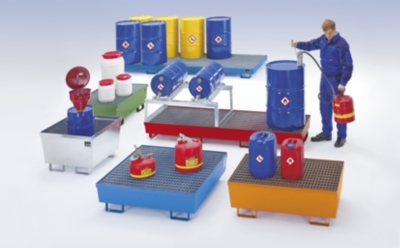
For storage of flammable liquids in GHS categories 1 – 3 as well as water hazardous liquids in GHS categories 1 – 4.
Sump trays made of polyethylene (PE)
PE sump trays exhibit a range of designs due to the injection moulding or rotational moulding processes, which allow for different uses and space requirements. They are lighter than steel trays, easier to handle and are corrosion resistant, making them suitable for use with many hazardous substances. However, they are not suitable for oil based or highly flammable liquids, as their fire resistance is limited. They also have lower mechanical strength, can deform under high loads and are susceptible to breakage when subject to high forces or low temperatures.
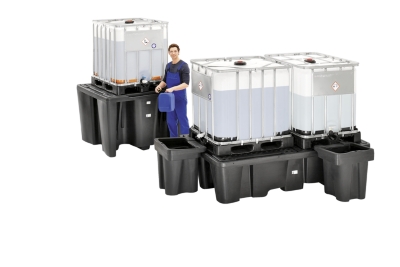
For storage of water hazardous liquids in GHS categories 1 – 4. In Germany, not permitted for storage of flammable media.
Sump trays made of glass fibre reinforced plastic (GRP)
GRP is a composite material made of polyester resin and glass fibre mats, which makes an impression with its high stability, low weight and resistance to fire. Compared to steel, GRP is corrosion resistant and can withstand many chemicals. GRP sump trays are weather resistant, do not require any additional protective measures and are easy to clean. However, they are not entirely suitable for flammable, hazardous substances and are mechanically less stable than steel trays, especially at low temperatures or when subject to heavy loads.
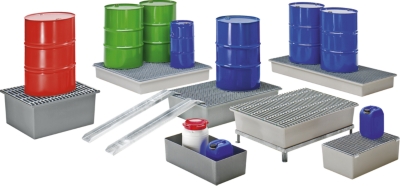
For the storage of water hazardous liquids in GHS categories 1 – 4 as well as flammable liquids (flash point >55 °C).
Sump tray compatibility checker
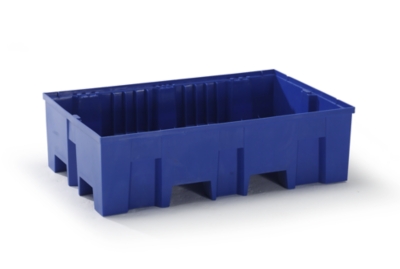
It is fast and easy to check whether sumps made of GRP or PE are suitable for the medium you wish to store using the compatibility checker.
For corrosive media or unspecified media, please enquire beforehand (with material safety data sheet).
Comparison of sump trays
| Steel | PE | GRP | |
|---|---|---|---|
| Weight | medium/high | low | low/medium |
| Corrosion resistance | medium | high | high |
| Flammability | non-flammable (class A1) | normally flammability (class B2) | low flammability (class B1) |
| Mechanical stability | high | low/medium | medium |
Suitability for stored media
| Steel | PE | GRP | |
|---|---|---|---|
| Used oil of known origin (flammable, flash point > 55 °C) | ✅ | ❌ | ✅ |
| Heating oil and diesel (flammable, flash point > 55 °C) | ✅ | ❌ | ✅ |
| Alkaline solutions up pH 8 | ✅ | ✅ | ✅ |
| Alkaline solutions > pH 8 | ❌ | ✅ | |
| Acids up 10% acid, saline solutions pH 6 – 8, fixing baths | ❌ | ✅ | ✅ |
| Acids up to 20% acid, battery acid 37% | ❌ | ✅ | ✅ |
| Petrol, nitro (highly flammable, flammable, combustible)* | ✅ | ❌ | ❌ |
* Additional requirements for the storage space must be observed. (Fire protection, explosion protection.)
Accessories you should not be without
A grate is virtually indispensable for a sump tray. It ensures even weight distribution and therefore increases stability, and larger containers in particular are much easier to place on a grate than manoeuvring them into the tray using a lifting device. Placing containers directly in the sump tray reduces the sump capacity and, in the event of a leak, the containers are standing in the escaping liquid. This means that not only will the sump tray require cleaning, but also the containers themselves.
When hazardous substances are not only being stored, but also have to be handled (for example, when filling or refilling) in particular, splash protection walls and filling containers ensure greater safety. Filling attachments or drum stands make work easier.
Installation conditions – legal requirements
Sump trays may only be installed in areas protected from precipitation, as any water that enters will reduce the sump capacity. Sump trays must be installed on level, sealed surfaces to ensure that the specified sump capacity can be complied with, and that the stored containers have a secure stand. Whether collision protection is necessary depends on the conditions in the space.
The containers must be stored on the tray in a way that ensures they do not protrude above the tray. This prevents them from falling down and, in the event of a leak, that any escaping liquids are collected. When using a container on the tray to fill other containers, ensure that the opening is above the tray. If this is not possible due to the dimensions of the container, a filling container should be used so that leaks from the tap and dripping liquids are safely collected. If the height required for filling into small containers is too small, or if the liquid is highly viscous, the use of a raised, sloping surface is recommended.
Plastic sump trays should not be exposed to direct UV light or temperatures above 30 °C for prolonged periods, as this can impair the material in the long term. Steel sump trays should always be positioned at a sufficient distance from other metal surfaces to avoid contact corrosion, and they should not be exposed to moisture for long periods of time.
When storing hazardous substances together in and on sump trays, in addition to the ban on combined storage, it must also be ensured that no substances are stored above a tray that could react with each other when in contact. Not only the suitability of the respective tray must be observed, but also potential exothermic reactions by the substances, especially in the case of polyethylene sump trays, which can result in the structural integrity of the sump tray being destroyed due to the resulting heat.
Hazardous substance symbols in accordance with GHS / REACH
Environmentally hazardous
Class: aquatic toxicity acute | H phrase: H 400 | Hazard category: GHS category 1
Class: aquatic toxicity chronic | H phrase: H 410 | Hazard category: GHS category 1
Class: aquatic toxicity chronic | H phrase: H 411 | Hazard category: GHS category 2
Class: aquatic toxicity chronic | H phrase: H 412 | Hazard category: GHS category 3
Class: aquatic toxicity chronic | H phrase: H 413 | Hazard category: GHS category 4
Flammable / highly flammable / extremely flammable
Class: extremely flammable | Criteria: flash point <23 °C Boiling point <35 °C | H phrase: H 224 | Hazard category: GHS category 1
Class: highly flammable | Criteria: flash point <23 °C Boiling point >35 °C | H phrase: H 225 | Hazard category: GHS category 2
Class: flammable | Criteria: flash point >23 °C <60 °C | H phrase: H 226 | Hazard category: GHS category 3
Corrosive
Toxic (T) Highly toxic (T+)
US American test certificates as quality verification

Environmental Protection Agency

Uniform Fire Code
Occupational Safety and Health Agency
National Fire Protection Agency

Factory Mutual (independent testing agency)

Contact us!
We are available to answer any further questions you might have.